3 Impacts of AI on Student Assessment Methods
Examine the 3 ways AI is changing how we assess student knowledge and measure academic success.
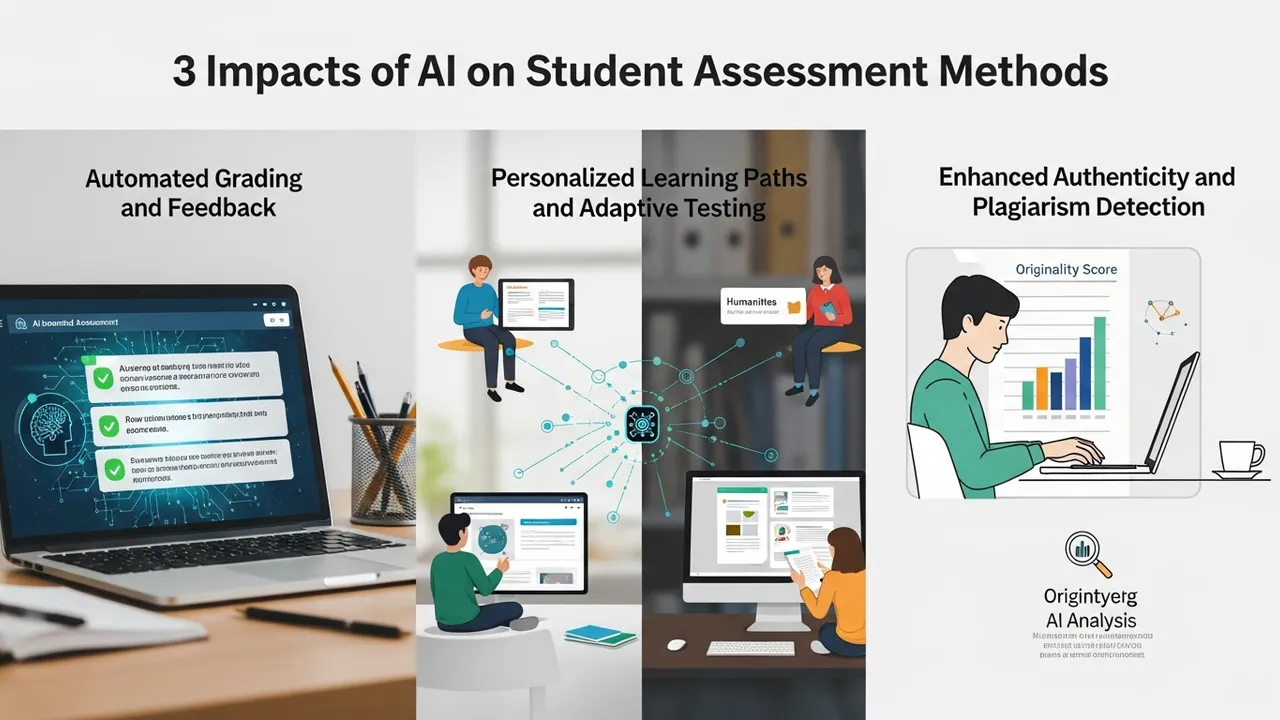
Examine the 3 ways AI is changing how we assess student knowledge and measure academic success.
3 Impacts of AI on Student Assessment Methods
If you have been paying attention to the classroom lately, you have probably noticed that the old-school way of testing—you know, the blue book exams and the high-stakes final papers—is starting to feel a bit like a relic from the past. Artificial Intelligence is shaking things up in a big way, and honestly, it is about time. We are moving away from the 'one size fits all' testing model and heading toward something that actually measures what a student knows rather than just how well they can memorize facts under pressure.
AI Driven Personalized Assessment Tools
The first major shift is the move toward adaptive testing. Instead of every student getting the exact same set of questions, AI platforms are now tailoring the difficulty level in real-time. If a student gets a question right, the system pushes them a bit harder. If they struggle, it pivots to offer foundational support. This is a game-changer for keeping students engaged without making them feel defeated.
Take Knewton Alta, for example. It is a powerhouse in the adaptive learning space. It doesn't just grade you; it identifies exactly which concept you missed and serves up a mini-lesson to fix that gap before you move on. It is like having a tutor sitting next to you during the test. Then there is ALEKS, which is widely used in math and chemistry. It uses knowledge space theory to map out exactly what a student is ready to learn next. Pricing for these tools usually depends on institutional licensing, but for individual access, you are looking at roughly $40 to $60 per course per semester. Compared to a traditional textbook, the value is massive because you are paying for a dynamic assessment engine, not just static pages.
Automated Grading and Instant Feedback Loops
Let’s be real: teachers are drowning in paperwork. Grading essays and complex assignments takes forever, and by the time a student gets their feedback, they have often moved on to the next topic. AI is stepping in to bridge that gap. Tools like Gradescope are absolute lifesavers here. It allows instructors to grade paper-based and digital exams much faster by grouping similar answers together. If you are grading 200 calculus exams, you can grade the same problem for everyone at once. It is incredibly efficient.
Another player is Turnitin Draft Coach. While it is often associated with plagiarism checking, its real power lies in the formative feedback it gives students *before* they submit their final work. It highlights grammar, citation issues, and structural flow. It turns the assessment process into a learning process. For schools, these tools are becoming standard. While the cost is usually handled at the district or university level, the ROI is measured in the hundreds of hours of teacher time saved per year. It means teachers can spend more time mentoring and less time with a red pen.
Predictive Analytics for Academic Success
The third impact is the shift toward predictive assessment. We are no longer just looking at a final grade; we are looking at the data trail a student leaves behind. AI can analyze how long a student spends on a module, how many times they re-watch a video, and how they perform on low-stakes quizzes to predict their final outcome. This allows educators to intervene before a student actually fails.
Platforms like Civitas Learning are leading this charge. They aggregate data from across the campus to give advisors a 'nudge' when a student is at risk. It is not about judging the student; it is about providing support exactly when it is needed. It changes the assessment from a 'gotcha' moment at the end of the term to a continuous support system. These systems are enterprise-level investments, often costing thousands of dollars, but the impact on retention rates is undeniable. When you can see the 'why' behind a student's struggle, you can actually do something about it. We are looking at a future where the 'final exam' might eventually disappear, replaced by a continuous, AI-monitored stream of competency data that gives a much more accurate picture of a student's true potential.
:max_bytes(150000):strip_icc()/277019-baked-pork-chops-with-cream-of-mushroom-soup-DDMFS-beauty-4x3-BG-7505-5762b731cf30447d9cbbbbbf387beafa.jpg)