4 Ethical Considerations for AI in Education
Learn about the 4 critical ethical considerations regarding AI use in education, including privacy and bias.
Learn about the 4 critical ethical considerations regarding AI use in education, including privacy and bias.
4 Ethical Considerations for AI in Education
The rapid integration of artificial intelligence into our classrooms and study routines has been nothing short of a revolution. From personalized tutors to automated grading systems, the potential is massive. But as we lean into these tools, we have to stop and ask ourselves: what are we actually trading for this convenience? It is not just about whether the tech works, but whether it works fairly and safely for every student involved. Let’s break down the four biggest ethical hurdles we are facing right now.
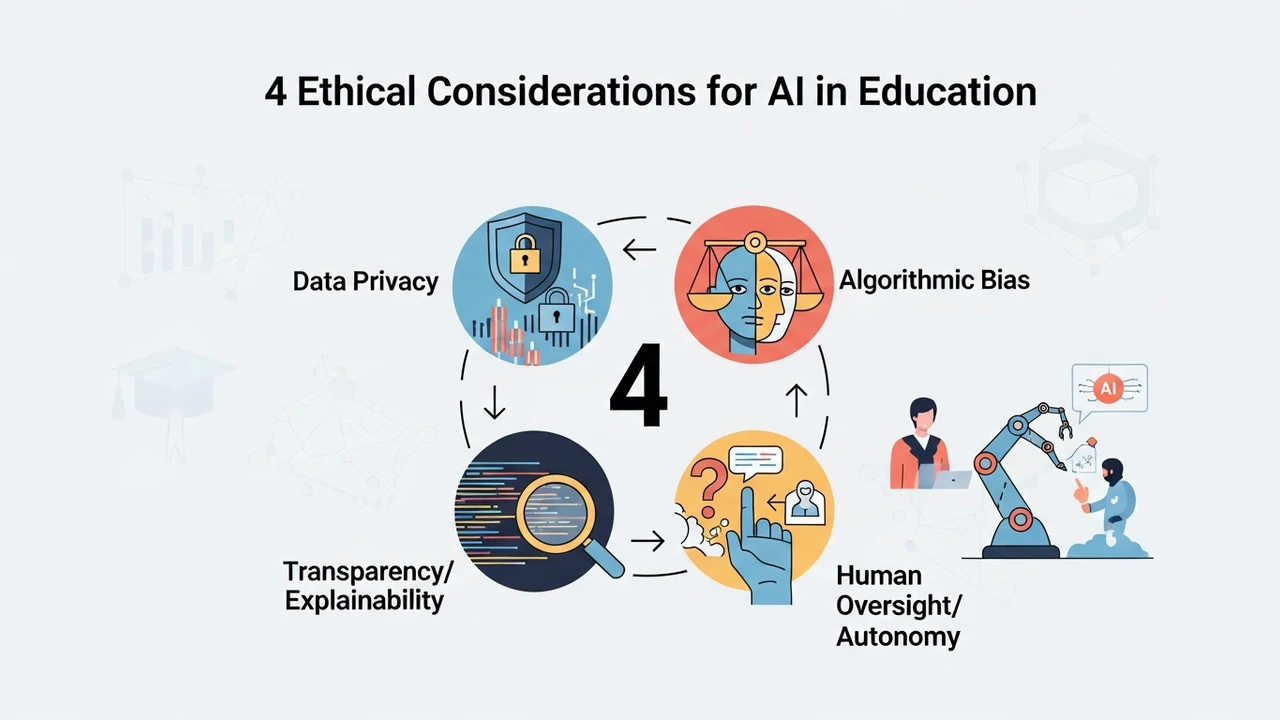
Data Privacy and Student Information Security
When we talk about AI, we are really talking about data. These systems need massive amounts of information to learn and adapt. In an educational setting, that means your data—or your students' data—is being fed into algorithms. The primary concern here is who owns that data and where it ends up. Many free AI tools operate on a model where the user is the product. If a student uses a free essay-writing assistant, is their work being stored to train future models? Is it being sold to third-party advertisers? We need to be hyper-aware of the terms of service.
For instance, tools like ChatGPT (OpenAI) and Claude (Anthropic) have enterprise versions that offer better data privacy, often costing around $20 to $30 per user per month. These are generally safer for institutional use compared to their free counterparts. On the other hand, apps like Grammarly have strict privacy policies, but users should always check if their data is being used for model training. Always look for tools that are FERPA or GDPR compliant if you are in a school setting.
Algorithmic Bias and Fairness in AI Learning Tools
AI is only as good as the data it was trained on. If the training data is biased, the output will be biased. This is a huge deal in education. Imagine an AI grading tool that consistently gives lower scores to students who use non-standard English dialects or come from specific cultural backgrounds. This isn't just a technical glitch; it is a systemic barrier to equality. We have seen instances where AI-powered recruitment tools favored certain demographics, and the same risks exist in educational assessment software.
When comparing tools like Turnitin, which uses AI for plagiarism detection, versus newer generative AI detectors, the accuracy varies wildly. Turnitin is a paid, institutional-grade tool that has spent years refining its database to minimize false positives. In contrast, many free online AI detectors are notoriously unreliable and often flag non-native English speakers as having used AI simply because of their sentence structure. If you are a teacher, you have to be skeptical of these tools. Never let an AI be the sole judge of a student's work.
Transparency and the Black Box Problem
Have you ever asked an AI a question and wondered how it came up with that answer? That is the 'black box' problem. In education, we value the 'why' as much as the 'what.' If an AI tutor tells a student they are wrong, but cannot explain the logic behind the correction, it is not teaching—it is just dictating. This lack of transparency makes it hard for educators to trust these systems. We need tools that show their work, cite their sources, and allow for human intervention.
Tools like Khanmigo, the AI tutor from Khan Academy, are designed with this in mind. They focus on the Socratic method, asking the student questions rather than just giving the answer. It costs about $9 per month for a subscription. Compared to a generic chatbot, Khanmigo is built specifically for the pedagogical process, making it much more transparent and educationally sound.
Human Agency and the Future of Teacher Student Relationships
The final, and perhaps most important, ethical consideration is the role of the human teacher. There is a real fear that we might replace meaningful human interaction with efficient but cold AI interfaces. Education is fundamentally a social process. It is about mentorship, empathy, and inspiration—things that a machine, no matter how advanced, cannot replicate. If we rely too heavily on AI, we risk turning education into a transactional experience where students just consume content rather than engaging in critical discourse.
We should view AI as a co-pilot, not an autopilot. Whether you are using Quizlet for flashcards or Canva Magic Studio for presentations, these tools should be used to free up your time so you can spend more time actually talking to your students. If you are spending 10 hours a week grading, and an AI can cut that to 2 hours, use those 8 hours to hold office hours or mentor students. That is where the real value lies. The goal is to use technology to amplify human connection, not to replace it.
:max_bytes(150000):strip_icc()/277019-baked-pork-chops-with-cream-of-mushroom-soup-DDMFS-beauty-4x3-BG-7505-5762b731cf30447d9cbbbbbf387beafa.jpg)