6 Best AI Tools for Customer Support Automation
Enhance your customer service experience with these 6 best AI tools for chatbots and automated support ticketing.
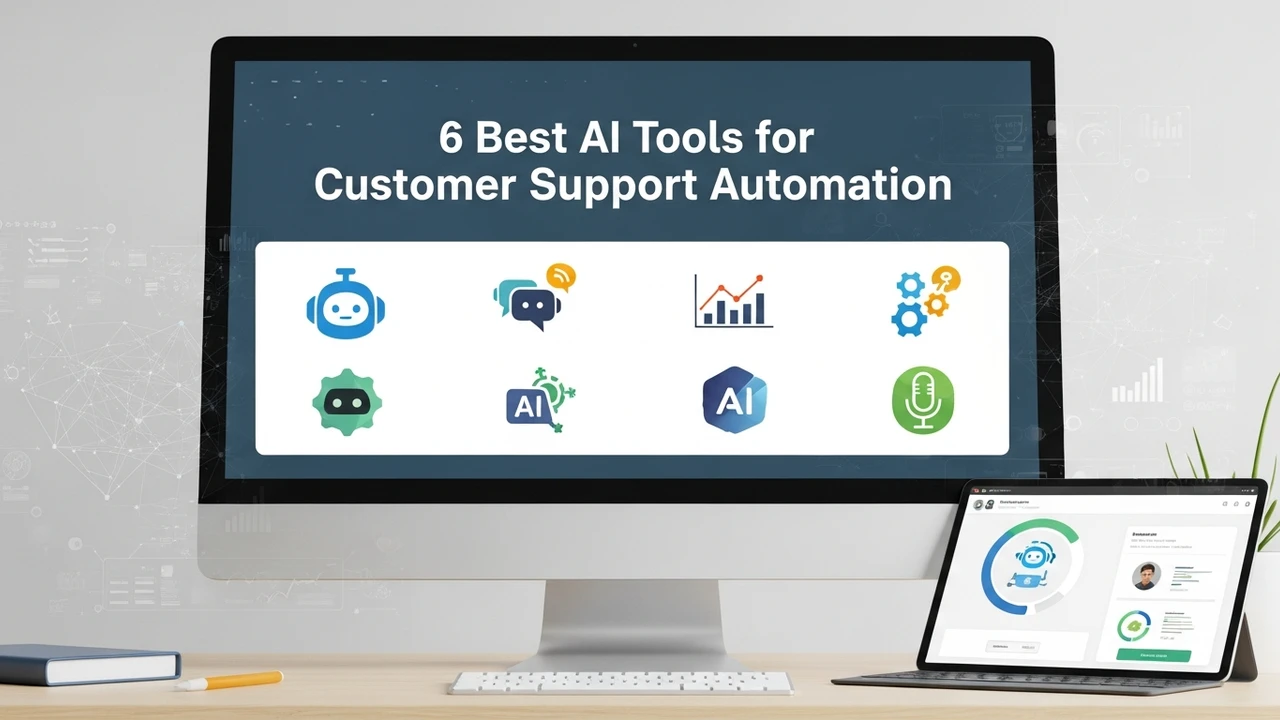
6 Best AI Tools for Customer Support Automation
Enhance your customer service experience with these 6 best AI tools for chatbots and automated support ticketing.
Why AI Customer Support Automation is a Game Changer
Let’s be real, nobody likes waiting on hold for twenty minutes just to ask a simple question about their order status. In today’s fast-paced digital world, customers expect instant gratification. If you are running a business, you know that scaling your support team is expensive and time-consuming. This is where AI customer support automation steps in. It is not just about replacing humans; it is about giving your team superpowers. By automating the repetitive stuff—like password resets, tracking numbers, and basic FAQs—you free up your human agents to handle the complex, emotional, and high-value conversations that actually build brand loyalty.
Top 6 AI Tools for Customer Support Automation
Choosing the right tool can feel overwhelming because there are so many options out there. I have spent time testing and comparing the top contenders to help you decide which one fits your business model best.
1. Intercom Fin
Intercom has been a leader in the space for a long time, and their new AI bot, Fin, is genuinely impressive. It uses GPT-4 to provide accurate answers based on your existing help center content. The best part? It doesn't hallucinate. It sticks to the documentation you provide. It is perfect for SaaS companies that need a reliable, smart assistant that feels like a natural extension of their brand.
2. Zendesk AI
If you are already using Zendesk, their AI features are a no-brainer. Zendesk AI excels at intent detection. It knows when a customer is frustrated versus when they are just asking for a refund. It routes tickets to the right agent automatically, saving your team hours of manual sorting every single week.
3. Tidio
Tidio is the go-to for small to medium-sized e-commerce businesses. It is incredibly easy to set up. You don't need to be a coder to build a chatbot that handles abandoned carts or answers shipping questions. It is affordable, intuitive, and integrates perfectly with Shopify and WordPress.
4. Freshdesk Messaging
Freshdesk is all about the omnichannel experience. Whether your customers are reaching out via WhatsApp, Facebook Messenger, or email, Freshdesk keeps everything in one place. Their AI-powered Freddy bot is great at suggesting responses to agents, which speeds up the resolution time significantly.
5. Ada
Ada is the enterprise-grade solution. If you are a large company with complex workflows, Ada is the one you want. It is highly customizable and can integrate with almost any backend system you have. It is more expensive, but for the level of automation it provides, it is worth every penny.
6. Gorgias
Gorgias is built specifically for e-commerce. It pulls data directly from your store, so it can tell a customer exactly where their package is without an agent ever needing to look at the order history. It is a massive time-saver for online retailers.
Comparing Features and Pricing Models
When you look at these tools, you have to consider your budget and your volume. Tidio starts very cheap, often with a free tier for basic needs, making it perfect for startups. Intercom and Ada operate on a more premium pricing model, often charging based on the number of resolutions or active users. Zendesk and Freshdesk usually offer tiered subscriptions that scale as your team grows. Think about your current ticket volume. If you are handling fewer than 500 tickets a month, a tool like Tidio or Gorgias will give you the best ROI. If you are handling 10,000+ tickets, you need the robust infrastructure of an Ada or Zendesk.
Real World Use Cases for AI Automation
Imagine a customer reaches out at 3 AM asking for a refund. Without AI, that customer waits until 9 AM for a response, and they are probably annoyed. With an AI bot, the bot verifies the order, checks your refund policy, processes the request, and sends a confirmation email—all while you are sleeping. That is the power of automation. Another use case is internal support. You can train an AI bot on your internal company wiki so that your employees can ask the bot how to request time off or how to access the VPN, rather than bothering the HR or IT departments.
How to Choose the Right AI Support Tool
Don't just pick the one with the most features. Pick the one that integrates with your current tech stack. If you use Shopify, look at Gorgias or Tidio. If you use Salesforce, look at Zendesk or Ada. Also, consider the learning curve. Some of these tools require a dedicated administrator to manage the AI training, while others are plug-and-play. Start with a trial, feed it your existing FAQ data, and see how it handles a few test conversations. You will quickly see which one feels right for your team's workflow.
:max_bytes(150000):strip_icc()/277019-baked-pork-chops-with-cream-of-mushroom-soup-DDMFS-beauty-4x3-BG-7505-5762b731cf30447d9cbbbbbf387beafa.jpg)