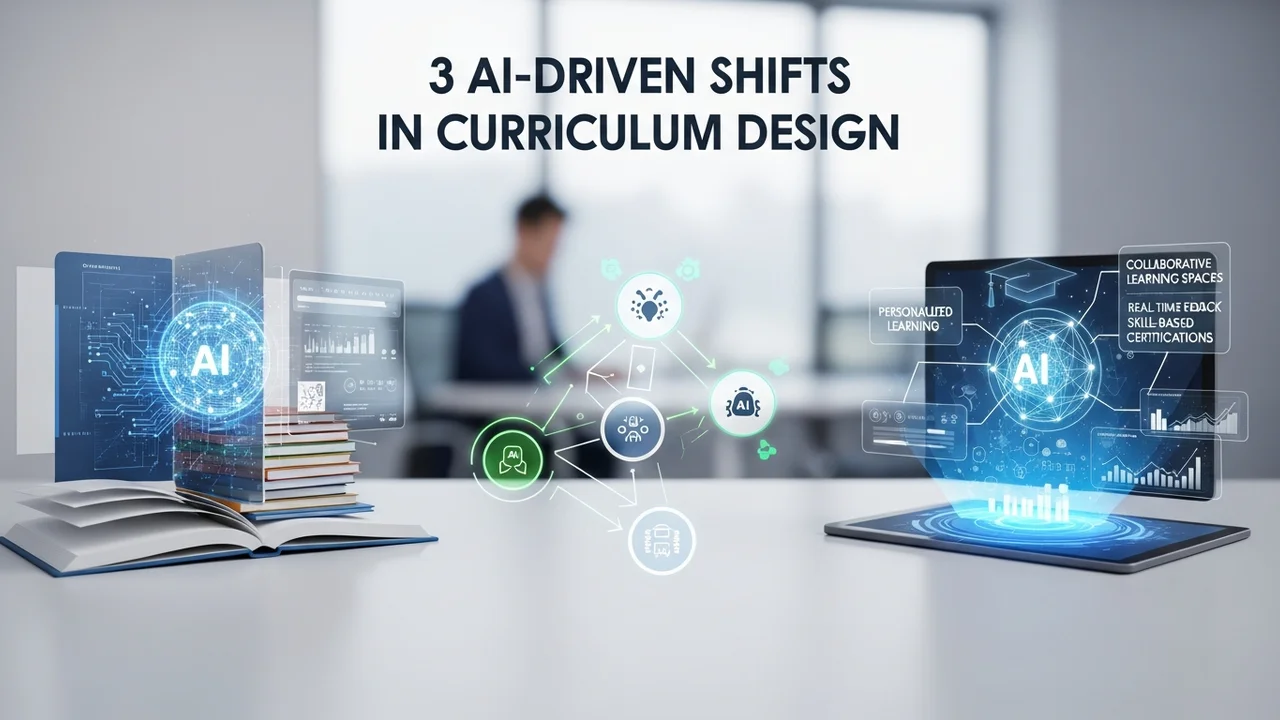
Understand the 3 major shifts in curriculum design caused by the integration of AI into educational standards.
Understand the 3 major shifts in curriculum design caused by the integration of AI into educational standards. As we navigate the rapidly evolving landscape of modern education, it is becoming increasingly clear that the traditional, static curriculum is no longer sufficient to prepare students for a future dominated by artificial intelligence. We are witnessing a fundamental transformation in how educational content is structured, delivered, and assessed. This shift isn't just about adding a coding class or a digital literacy module; it is about rethinking the very architecture of learning.
The Shift Toward Personalized Adaptive Learning Paths
One of the most significant changes we are seeing is the move away from the 'one-size-fits-all' model. Historically, curriculum design was linear—everyone learned the same thing at the same time. AI is shattering this paradigm. By using adaptive learning platforms, educators can now create dynamic curricula that adjust in real-time based on a student's performance, pace, and learning style. If a student struggles with a specific concept in algebra, the AI doesn't just move on; it identifies the gap, provides alternative explanations, and offers targeted practice until mastery is achieved.
When we look at products like Knewton Alta or DreamBox Learning, we see this in action. Knewton Alta, for instance, is a courseware platform that uses AI to provide students with personalized instruction. It costs roughly $40 per student per course, making it a highly accessible option for higher education institutions. Compared to traditional textbooks, which are static, Knewton provides a living, breathing curriculum. Another player, DreamBox, focuses on K-8 math and uses an intelligent engine to adapt to student responses, often priced around $12.95 per month for individual families. These tools allow teachers to act more like mentors than lecturers, as the AI handles the heavy lifting of content differentiation.
Integrating AI Literacy as a Core Competency
Another major shift is the integration of AI literacy directly into the curriculum, rather than treating it as an elective. We are moving toward a world where understanding how to prompt, audit, and collaborate with AI is as fundamental as reading and writing. This means that history, science, and literature curricula are being redesigned to include AI-assisted research and critical analysis. Students are no longer just memorizing facts; they are learning how to verify information generated by LLMs and how to use AI to synthesize complex datasets.
Tools like ChatGPT Enterprise or Microsoft Copilot are becoming standard in these environments. While ChatGPT Enterprise pricing is custom-quoted based on organizational needs, it offers robust security and data privacy, which is crucial for schools. Microsoft Copilot, integrated into the Office 365 suite, costs about $30 per user per month. These tools are being used in classrooms to help students draft outlines, brainstorm creative writing topics, and even debug code. The comparison here is clear: while traditional search engines provide a list of links, these AI tools provide a starting point for synthesis, forcing students to develop higher-order thinking skills to refine the output.
Moving from Summative Assessment to Continuous Feedback Loops
Finally, the third shift is the move away from high-stakes, end-of-term exams toward continuous, AI-driven feedback loops. In the past, a student might wait weeks to get feedback on a major project. Today, AI tools can provide instant, formative feedback on drafts, allowing students to iterate and improve their work in real-time. This changes the curriculum from a series of 'tests' to a series of 'projects' where the process of learning is valued as much as the final result.
Platforms like Gradescope and Turnitin Draft Coach are leading this charge. Gradescope, which is now part of Turnitin, uses AI to help instructors grade assignments faster and provide more consistent feedback. It is widely used in STEM fields and typically follows an institutional licensing model. Turnitin Draft Coach, on the other hand, works directly within Google Docs or Microsoft Word to provide students with real-time feedback on their writing, grammar, and citation accuracy before they even submit their work. This is a game-changer for academic integrity and skill development. By shifting the focus to the process, we are teaching students that learning is an iterative journey, not a destination marked by a letter grade. As these technologies continue to mature, the gap between the 'average' student and the 'top' student will likely narrow, as everyone will have access to a personalized, AI-powered tutor that never gets tired and is always ready to help.
:max_bytes(150000):strip_icc()/277019-baked-pork-chops-with-cream-of-mushroom-soup-DDMFS-beauty-4x3-BG-7505-5762b731cf30447d9cbbbbbf387beafa.jpg)