4 Ways AI Can Bridge the Education Gap
Discover how AI technology can help provide quality education to underserved communities and bridge the learning gap.
Discover how AI technology can help provide quality education to underserved communities and bridge the learning gap.
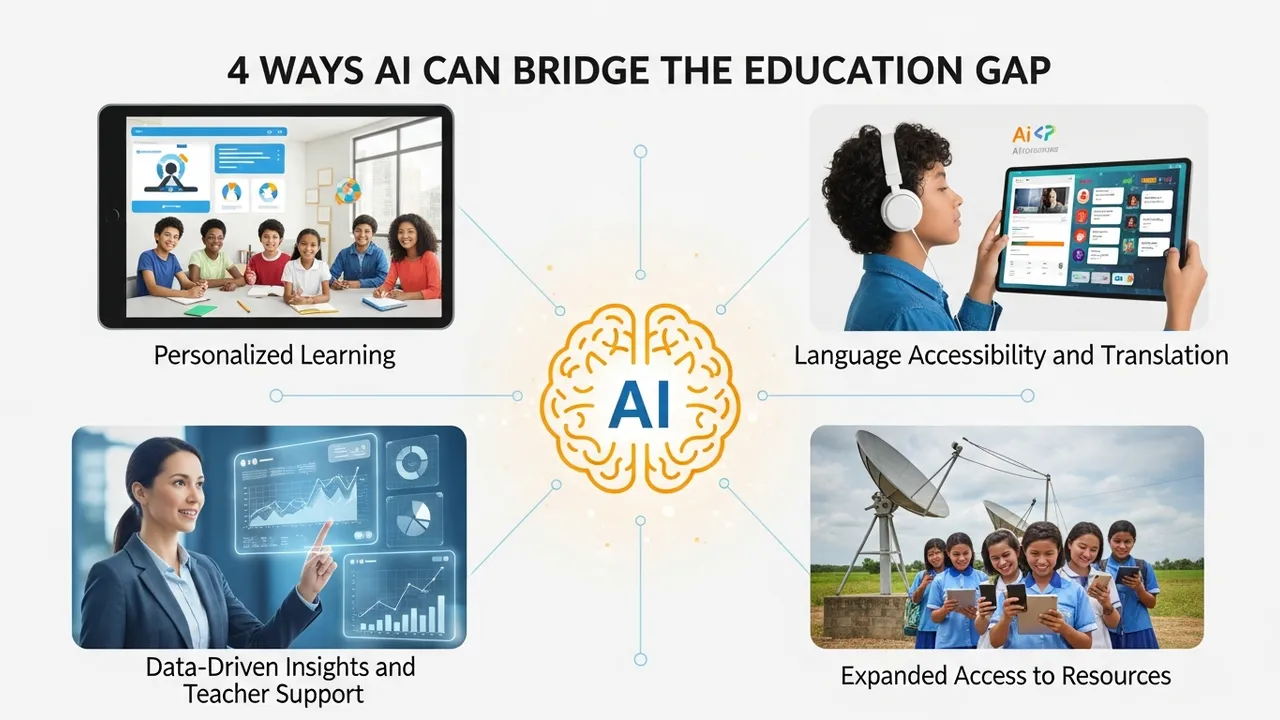
4 Ways AI Can Bridge the Education Gap
Let’s be real for a second—the education system has been struggling with inequality for decades. Whether you are in a rural village in Southeast Asia or an underfunded school district in the United States, the story is often the same: not enough teachers, outdated resources, and a one-size-fits-all curriculum that leaves half the class behind. But here is where things get interesting. Artificial Intelligence isn't just a buzzword for tech bros; it is actually becoming a massive equalizer. We are talking about tools that can act as personal tutors, language translators, and curriculum designers all at once. It is about time we looked at how this tech is actually changing the game for students who have been left in the shadows.
Personalized AI Learning Paths for Diverse Student Needs
The biggest issue in traditional classrooms is that teachers have to teach to the middle. If you are ahead, you get bored. If you are behind, you get lost. AI changes this by creating adaptive learning paths. Platforms like Khan Academy with their Khanmigo tool or Duolingo’s AI-driven lessons are perfect examples. These tools analyze exactly where a student is struggling and adjust the difficulty in real-time. For a student in a remote area with limited access to high-quality instruction, having an AI that explains a math concept in five different ways until it clicks is a total game-changer. It’s like having a private tutor that never gets tired and never judges you for asking the same question ten times.
AI Language Translation Tools for Global Accessibility
Language barriers are a huge reason why many students drop out or fail to engage with global educational content. If your native language isn't English, you are already at a disadvantage in the global job market. AI-powered translation tools like DeepL or Google Translate’s advanced API integrations are breaking these walls down. Imagine a student in Vietnam accessing a top-tier lecture from a Harvard professor, but with real-time, accurate subtitles in their own language. This isn't just about translation; it is about cultural and intellectual inclusion. We are seeing tools like Microsoft Translator for Education being used in classrooms to ensure that every student, regardless of their mother tongue, can participate in the conversation.
AI Powered Content Creation for Resource Scarce Environments
In many parts of the world, teachers are overworked and lack the time to create high-quality lesson plans. This is where generative AI tools like ChatGPT, Claude, or specialized EdTech platforms like Curipod come in. These tools allow a teacher with limited resources to generate a full week’s worth of lesson plans, quizzes, and visual aids in minutes. Instead of spending hours writing out worksheets, they can spend that time actually mentoring students. It’s about efficiency. When you give a teacher better tools, the quality of education for every single student in that room goes up. It’s a force multiplier for human effort.
Bridging the Digital Divide with Low Bandwidth AI Solutions
One of the biggest criticisms of AI in education is that it requires high-speed internet. But the industry is shifting. We are seeing the rise of 'offline-first' AI models and lightweight apps that run on basic smartphones. Tools like Kolibri or various SMS-based AI tutoring services are designed specifically for areas with spotty connectivity. These platforms provide high-quality educational content without needing a fiber-optic connection. By focusing on accessibility, these developers are ensuring that the AI revolution doesn't just benefit the wealthy, but actually reaches the students who need it the most.
Comparing Top AI Tools for Educational Equity
If you are looking to implement these tools, you need to know what is out there. Let’s break down a few key players. Khanmigo is fantastic for personalized tutoring, usually costing around $9 per month, and it is arguably the gold standard for adaptive learning. Then you have Curipod, which is great for interactive lessons; they have a free tier, but their premium features for schools run about $100 per teacher annually. For translation, DeepL is far superior to standard tools, offering a free version and a Pro version starting at roughly $8.74 per month. Each of these tools serves a different part of the gap—some focus on the student, some on the teacher, and some on the language barrier. Choosing the right one depends on whether you are trying to fix a lack of content or a lack of personalized attention.
The reality is that we are just scratching the surface. The goal isn't to replace teachers with robots—that would be a disaster. The goal is to give every student, no matter where they are born or how much money their parents make, a fair shot at learning. When you combine human empathy with the scalability of AI, you get a system that actually works for everyone. It’s not just about the tech; it’s about the opportunity. And honestly, that is the most exciting part of the whole journey.
:max_bytes(150000):strip_icc()/277019-baked-pork-chops-with-cream-of-mushroom-soup-DDMFS-beauty-4x3-BG-7505-5762b731cf30447d9cbbbbbf387beafa.jpg)